
This year's AI Index report reveals AI's capabilities are advancing quickly; less so, our ability to measure and manage them.
Led by a steering committee of academic and industry experts and produced by the Stanford Institute for Human-Centered AI, the Artificial Intelligence Index has tracked the field's evolution since 2017, measuring everything from technical capabilities and research output to societal impact and public perception. What began as an effort to bring rigor and transparency to AI's rapid development has become the field's most comprehensive annual snapshot—a data-driven portrait of where artificial intelligence stands, where it's headed, and what it means for society.
The new report shows that AI models are achieving breakthrough results in science and complex reasoning, but at a concerning environmental toll. America is outspending any other country on AI, but is finding it harder to attract top talent. Meanwhile, AI’s workforce disruption has moved from prediction to reality, hitting young workers first.
What follows are the year’s most significant developments in AI, or read the full report.
Power-Hungry Models

As AI's capabilities improve, its environmental impact increases. Grok 4's estimated training emissions reached 72,816 tons of CO2 equivalent, or roughly the same amount of greenhouse gas emissions created from driving 17,000 cars for one year. AI data center power capacity rose to 29.6 GW, or about what it takes to power the entire state of New York at peak demand, and annual GPT-4o inference water use (the water used to cool data servers or run them off hydroelectricity) alone may exceed the drinking water needs of 12 million people.
For perspective, the cumulative power demand of all-in AI systems is comparable to the national electricity consumption of Switzerland or Austria.
China/US: The Lead Evaporates

For years, the U.S. outpaced all other global regions on AI - in model size, performance, artificial intelligence research, citations, and more. But China emerged as an AI counterweight to the U.S., gradually gaining ground, and this year it appears to have nearly erased any U.S. lead. U.S. and Chinese models have traded places at the top of the performance rankings multiple times since early 2025. In February 2025, DeepSeek-R1 briefly matched the top U.S. model, and as of March 2026 Anthropic's top model leads by just 2.7%. The U.S. still produces more top-tier AI models and higher-impact patents, while China leads in publication volume, citations, patent output, and industrial robot installations.
America’s Draw Fades

Asterisks indicate that a country’s y-axis label is scaled differently than the y-axis label for the other countries.
The U.S. is home to the most AI researchers and developers of any country by far, but the flow of these experts into the country is dramatically slowing. The number of AI scholars moving to the United States has dropped 89% since 2017. That decline is accelerating, down 80% in the last year alone.
AI Can Win a Mathematical Olympiad But Can’t Tell Time
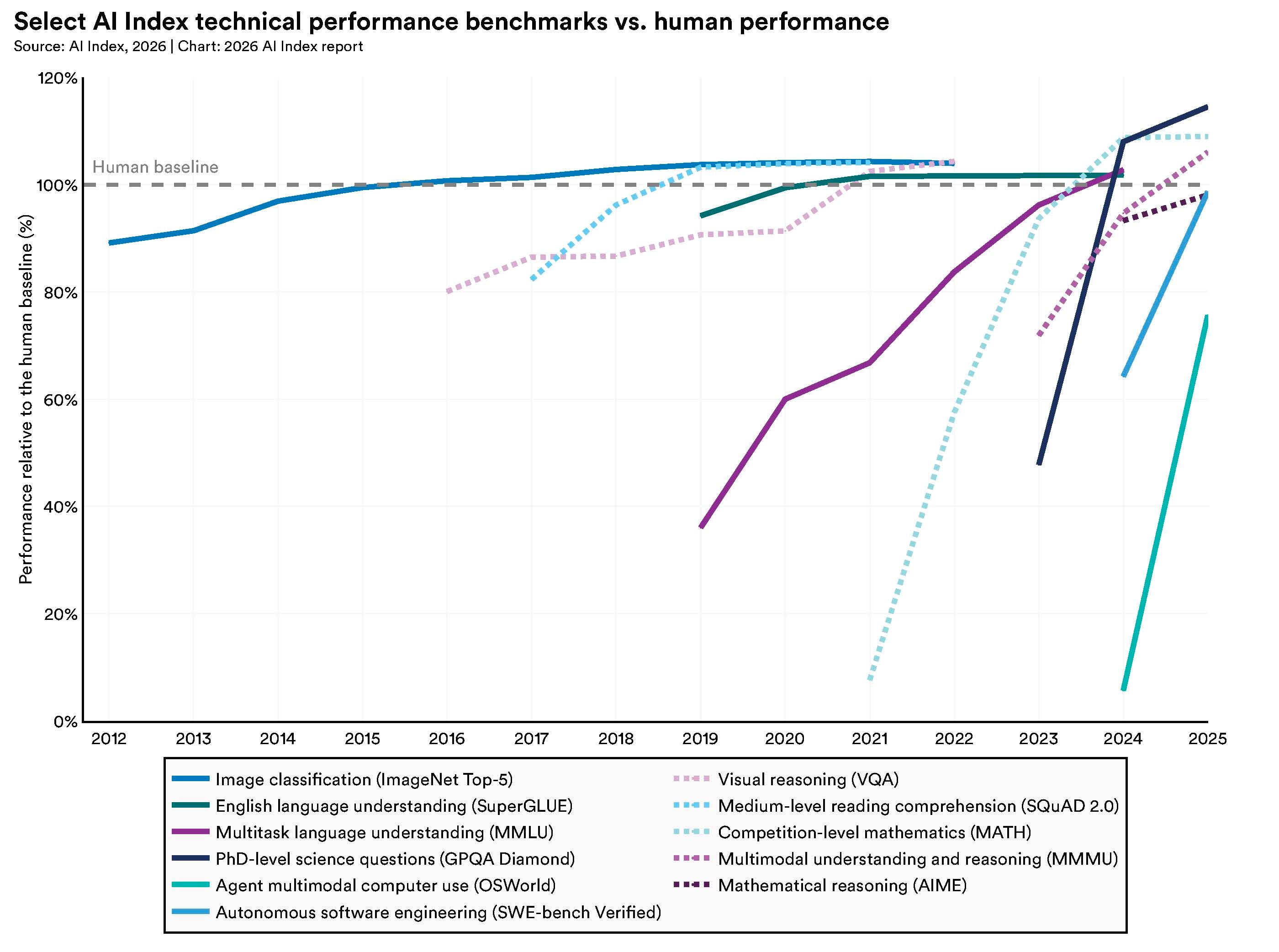
AI continues to expand its capabilities, hitting higher scores on benchmarks across types. But not all capabilities are evenly distributed. Frontier models now meet or exceed human capabilities on items like PhD-level science questions, multimodal reasoning, and competition mathematics. Other areas that had been performing poorly saw huge growth. For example, the success rate of agents handling real-world tasks improved from 20% in 2025 to 77.3% today, according to Terminal-Bench, while AI agents handling cybersecurity issues solved problems 93% of the time compared to 15% in 2024.
At other tasks, AI lags behind, including learning from video, generating video that is coherent and realistic, telling time, managing multiple-step planning, conducting financial analysis, and answering certain expert-level academic exams. Robots still have far to go on managing household chores—they succeed in only 12% of real household tasks like folding clothing or washing dishes.
The AI Investment Surge
More and more money is flowing into AI; global corporate AI investments hit $581.7 billion in 2025, up 130% from the prior year. Meanwhile, private investments reached $344.7 billion, an increase of 127.5% from 2024. The United States leads all other countries in doling out AI dollars: Its investments ($285.9 billion) were 23.1 times greater than those of the next-highest country, China ($12.4 billion). However, comparisons based solely on private investment likely understate the amount of capital China is directing toward AI. The Chinese government channels resources through government guidance funds, state-initiated investment funds that produce financial returns and further the government’s strategic priorities. Between 2000 and 2023, it was estimated that $912 billion of these funds were deployed across industries, including AI.
An Entry-Level Squeeze
Productivity gains from AI are appearing in many of the same fields where entry-level employment is starting to decline. Employment among software developers aged 22–25 has plummeted nearly 20% since 2024, even as their older colleagues' headcount grows. The pattern repeats in other jobs with higher levels of AI exposure, like customer service. Meanwhile, firm surveys indicate executives expect this trend to accelerate, with planned headcount reductions outpacing recent cuts. Translation: The disruption is targeted and just beginning.
AI as Scientist and Lab Assistant
AI is driving more scientific research, moving beyond a research tool that helps write papers or check numbers and toward actual discovery in science. AI-related publications in the natural, physical, and life sciences all increased 26% to 28% year over year. Some exciting projects for the year: For the first time, AI ran a full weather forecasting pipeline end-to-end—it took raw, real-time meteorological observations and directly output final weather predictions like temperature, wind, and humidity. Astronomy also built its first foundation model, automating astronomical observations across 10 telescopes.
Power and Opacity

Today’s most capable modern models are now among the least transparent. Giant, powerful models are concentrated within the largest AI companies, which are increasingly keeping training code, dataset sizes, and parameter counts to themselves. The Foundation Model Transparency Index, which measures how openly major AI companies disclose details about their models' training data, compute, capabilities, risks, and usage policies, saw average scores drop to 40 points from last year’s 58. The index noted that the most capable models often disclose the least amount of information.
Feelings on AI: Frenemies?

Public sentiment toward AI is growing more complex. In a global survey of public attitudes and perceptions on AI, 59% of people reported feeling optimistic about the benefits, up from 52%. The survey also noted a small uptick in nervousness around the technology - a 2% increase to 52%. The U.S. is more wary than other countries. Only 33% of Americans expect AI to make their jobs better, compared to a global average of 40%, and people in the U.S. are among the highest in expecting AI to eliminate jobs rather than create new ones. The U.S. public also reported the lowest trust in its government to regulate AI among the countries surveyed, at 31%.
Generative AI: More Popular Than the Internet?

AI adoption is spreading at historic speed, and consumers are deriving substantial value from tools they often access for free. Generative AI reached 53% population adoption within three years, faster than the personal computer or the internet, though the pace varies by country and correlates strongly with GDP per capita. Some show higher-than-expected adoption, such as Singapore (61%) and the United Arab Emirates (54%), while the U.S. ranks 24th at 28.3%. The estimated value of generative AI tools to U.S. consumers reached $172 billion annually by early 2026, with the median value per user tripling between 2025 and 2026.
The Self-Education Wave
Formal education is lagging behind AI use, but people are learning it at every stage of life. Four out of five U.S. high school and college students now use AI for school-related tasks, but only half of middle and high schools have AI policies and just 6% of teachers say those policies are clear. Outside the classroom, professionals are picking up both soft AI skills (like prompts) as well as more technical skills; the United Arab Emirates, Chile, and South Africa are learning AI engineering skills fastest.
AI Is Your Doctor’s Assistant
AI has entered the clinic. Tools that automatically generate clinical notes from patient visits saw widespread adoption in 2025. Across multiple hospital systems, physicians reported up to 83% less time spent writing notes and significant reductions in burnout. But beyond certain tools, the value of clinical AI remains speculative. A review of more than 500 clinical AI studies found that nearly half relied on exam-style questions rather than real patient data, with only 5% using real clinical data.
Another area of growth in medical AI is in data twins, or dynamic, data-linked computational representations of individual patients that update over time and support forecasting, simulation and treatment optimization. Publication counts rose from near 0 in 2015 to 372 in 2025, and where rigorous trials exist, early results are promising.
Originally published on the Stanford Institute for Human-Centered Artificial Intelligence (Stanford HAI) and republished here on Digital Information World with permission.
Reviewed by Ayaz Khan.
Read next:
• Industries most exposed to AI are not only seeing productivity gains but jobs and wage growth too
